Whittier · $200–$600
Main water line leaks in Whittier
Whittier's position against the Puente Hills means many homes have service lines that run uphill or downhill under driveways, steps and walls. Leaks on those lines rarely surface where they start.
Answered 24/7
Nights, weekends, holidays
Licensed local plumbers
Licensed in California
Pinpoint locating
Acoustic, thermal, tracer gas
Price ranges up front
Know the range before they come
Three kinds of Whittier lot
| Lot type | Typical line | Leak clue |
|---|---|---|
| Uptown / older streets | Older steel or copper, short run, sometimes replaced piecemeal | Water at the sidewalk or front lawn |
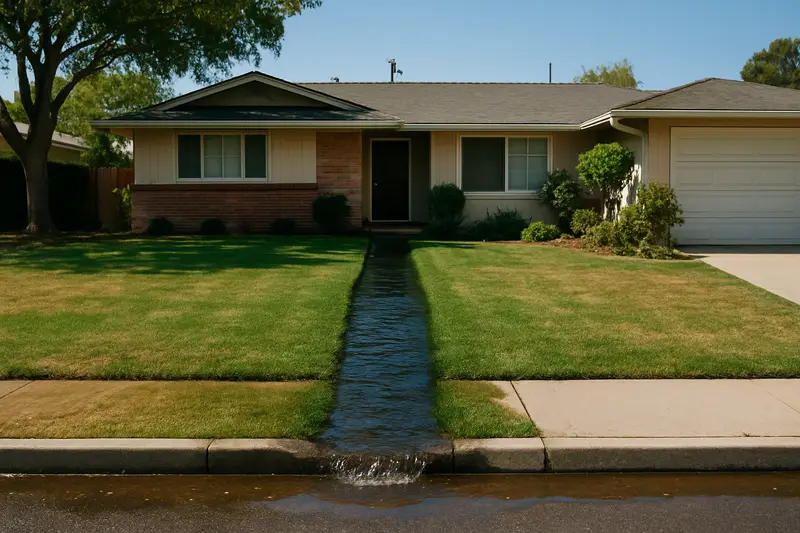
| Flat post-war tracts | Copper under the front lawn | Soft green strip in the lawn |
| Hillside lots north of Whittier Blvd | Long run under steps, walls, driveways | Water at the base of a wall or downhill |
Pressure is part of the story
Homes lower on the hill can see high street pressure. The pressure regulator near the house steps it down; when it fails, every pipe (including the service line) runs at full street pressure. Banging pipes, a dripping water heater relief valve, or toilets that refill noisily are signs. Have it tested whenever a service line leak is found.
Locating on a slope
- 1
Confirm it's the service line
Close the house valve; if the meter keeps moving, the leak is outside.
- 2
Trace the route
A line locator or the logical path from meter to valve shows where the pipe runs.
- 3
Listen along it
Hardscape carries sound well, which helps on driveways and steps.
- 4
Tracer gas for deep or quiet leaks
Gas rises through soil and is detected where it surfaces.
Repair or replace
If the line has leaked before or is old steel, replacement is usually better value, and on a hillside a new line can often be bored or pulled through rather than trenched across a slope.
After the repair
On hillside lots, saturated soil can take time to drain. If a retaining wall was weeping, it's worth keeping an eye on it through the next rainy season.
- Ask for a pressure reading at a hose bib before and after, and whether the regulator should be replaced
- Keep the invoice and photos for your water provider's leak adjustment
- Watch the soil around retaining walls for a few weeks as it dries out
- Check the meter again a week later with everything off, to be sure there isn't a second leak
Whittier water line costs
| Job | Typical range |
|---|---|
| Locating on a flat lot | $150–$500 |
| Locating on a slope | $250–$700 |
| Repairing a section | $600–$2,500 |
| Replacing a hillside line | $3,000–$9,000+ |
| Pressure regulator | $350–$900 |
Lines under steps and terraces
Many Whittier hillside homes have front steps, terraced gardens and retaining walls between the street and the house. Service lines often run beneath these features. When a leak occurs, water may appear at the base of a step, seep from a wall or soak a lower terrace. Pinpointing the leak before digging is especially important, because removing and rebuilding steps or walls is expensive. A tracer maps the line, and acoustic listening finds the leak so only a small section needs to be opened.
Which provider to call
Whittier is served by more than one water provider, and the one serving your street is named at the top of each statement. If water is surfacing at the meter or in the street, call that provider. If the meter moves with the house valve closed and nothing is visible at the street, the leak is on your side, and a plumber is the right call.
After the repair
- Watch the area for a few weeks to make sure the soil dries out
- Check retaining walls and steps for any movement or new cracks
- Have house pressure checked if the regulator is old
- Keep a sketch of where the line runs for future reference
Flat lots in south and west Whittier
Not every Whittier home is on a hill. The flatter neighborhoods to the south and west were built out after the war with single-story homes on modest lots, and their service lines run a short, straight distance from the meter at the curb to the front of the house. A leak on one of these lines usually shows up as a soggy strip of lawn, a damp patch along the driveway or water seeping from a crack in the front walk. Locating is quick, and repairs are typically small. If the line is original galvanized, though, replacing it outright is often the better choice, since one leak tends to be followed by another.
When pressure is too high
Homes lower on Whittier's slopes can receive water at high pressure, and the regulator near the main shutoff is what brings it down to a safe level for household plumbing. When a regulator fails, pressure on the service line, fittings and fixtures climbs. Signs include banging pipes when a faucet closes, a water heater relief valve that drips, toilets that keep running and faucets that wear out quickly. Over time, high pressure can contribute to leaks on the service line itself. A plumber can test pressure in minutes and replace a failed regulator as part of a leak repair visit.
Signs worth photographing
- Water seeping from the face or base of a retaining wall
- A wet patch that stays wet even in warm, dry weather
- Sinking pavers, steps or soil along the line's route
- A meter box that's full of water
Old shutoff valves
Have the house shutoff checked during the repair; older valves may not close fully.
Who's responsible for what
The water provider is responsible for the meter and the line from the street to the meter. The homeowner is responsible for the line from the meter to the house and everything inside. If the leak is at the meter or on the street side, the provider will repair it at no cost to you. If it's on your side, you'll need a plumber. When in doubt, call the provider first; they can check the meter and tell you which side the problem is on.
Winter rains and slope leaks
Whittier's winter storms can soak hillsides quickly, and that can hide a service line leak or make one look worse. If a wet area stays wet for days after the rain has stopped and the rest of the yard has dried, the line is the likely cause. Check the meter with the house shutoff closed to confirm. Getting the leak fixed before the next storm keeps the slope from carrying extra water it doesn't need.
Questions people ask
Water is coming out of my retaining wall. Is it the main line?+
Possibly, or it could be irrigation or groundwater. Close the house valve and watch the meter; if it keeps moving, the service line is a strong suspect.
Who supplies my water in Whittier?+
Either the city or a private water company, depending on your neighborhood. The meter and the street side are theirs; the line to your house is yours.
Can a high-pressure regulator cause leaks?+
A failed regulator lets street pressure through, which strains every pipe and joint. It's a common contributing factor.