Guide · updated 2026-10-02
Slab leak repair vs reroute vs repipe
Once a slab leak is found, there are three ways to deal with it. The right one depends less on the leak and more on the pipe around it, the floor above it, and how long you plan to stay.
The three options at a glance
| Spot repair | Reroute | Repipe | |
|---|---|---|---|
| Typical range | $1,500–$4,500 | $2,000–$6,500 | $5,000–$16,000 |
| Floor opened? | Yes, at the leak | No | No |
| Walls opened? | No | A few small openings | Several small openings |
| Time | 1–2 days plus concrete cure | 1–2 days | 2–5 days |
| Fixes | This leak | This line | Every supply line |
Spot repair: when it makes sense
The plumber cuts and breaks out a section of slab over the marked leak, digs down to the pipe, replaces the damaged piece, pressure-tests, backfills and patches the concrete. It's the most direct fix and works well when the leak is under easy flooring, a garage, a utility room, carpet that can be rolled back, and the rest of the pipe is in reasonable condition.
The catches: flooring repair can cost as much as the plumbing, especially for tile that's no longer made, and the other buried pipe is the same age as the piece that failed.
Reroute: the usual middle path
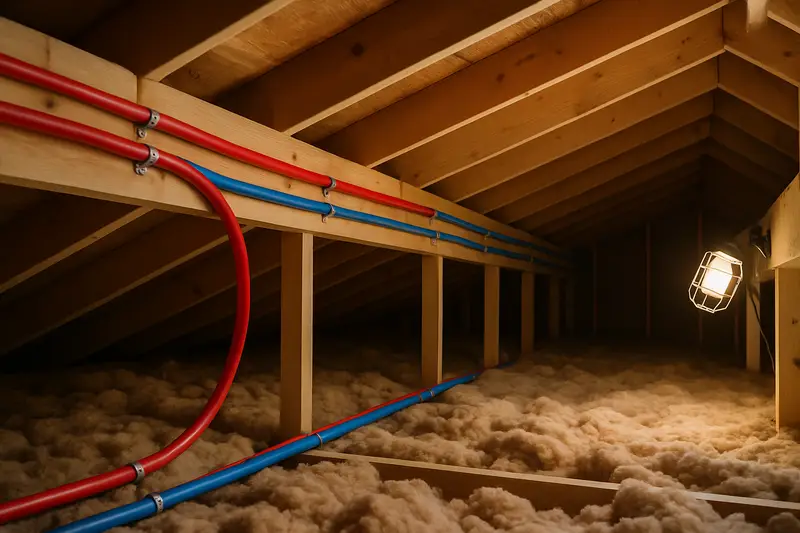
Instead of going after the leak, the plumber cuts the leaking line off at both ends where it comes out of the slab and runs a new line through the attic or walls to replace it. The old pipe stays in the ground, disconnected.
Reroutes are common in Orange County slab homes because they avoid breaking floors and remove the failing pipe from service. Expect a few small openings in walls or ceilings to drop the new line down to fixtures. PEX is the usual material; insulated where it runs through a hot attic.
Repipe: when the pattern says so
If this is the second or third slab leak, or copper elsewhere in the house has pinholed, the remaining buried lines are likely on the same path. A whole-house repipe moves every supply line overhead and ends slab leaks on the supply side for good. It's the biggest upfront cost but often the cheapest over ten years. See repiping after repeat leaks.
How to decide
- 1
Count past leaks
First leak in an otherwise healthy system: spot repair or reroute. Second leak: lean to reroute. Third: get a repipe price.
- 2
Look at what's above it
Under expensive or irreplaceable flooring, or under kitchen cabinets, a reroute usually wins.
- 3
Think about your timeline
Selling within a couple of years? A clean spot repair with documentation may be enough. Staying a decade? Removing buried pipe from service has more value.
- 4
Check the insurance angle
Some policies pay toward breaking and restoring the slab to reach the pipe. That can tilt the numbers toward a spot repair, so ask your insurer.
- 5
Get prices side by side
Ask the plumber to price the options in writing so you're comparing the same scope, including patching.
Real-world scenarios
| Situation | Usually the best fit | Why |
|---|---|---|
| First leak, under carpet in a bedroom, copper elsewhere looks good | Spot repair | Easy access, low cost, limited risk |
| First leak under a tiled kitchen or hallway | Reroute | Avoids breaking and matching tile |
| Second leak on the hot line in five years | Reroute of the whole hot side | Removes the failing run entirely |
| Leaks on both hot and cold lines | Repipe | The system is wearing out |
| Leak in a home being remodeled | Repipe | Walls are open anyway |
What a spot repair involves, step by step
- 1
Mark
The plumber pinpoints the leak and marks it on the floor.
- 2
Open
Flooring is removed and a small section of concrete is cut and broken out.
- 3
Repair
The leaking section of pipe is cut out and replaced, then pressure tested.
- 4
Close
The hole is backfilled and patched with concrete. Flooring repair follows.
What a reroute involves
A reroute disconnects the leaking line where it enters the slab and runs a new line through the attic or walls to the same fixtures. In single-story homes, that usually means going up from the water heater or main line into the attic, across the house and down into the bathroom or kitchen wall. Small holes are cut in drywall where lines drop down, and those are patched afterward. The old line under the slab is capped and abandoned in place. Most reroutes take a day or two, and water is usually restored the same evening.
The materials are usually PEX or copper. PEX is flexible, quick to install and resistant to the kinds of corrosion that cause pinholes. Copper is traditional and durable. Your plumber can explain which they recommend and why.
What happens to the floor
With a spot repair, the floor is the big variable. Carpet can usually be pulled back and reinstalled. Vinyl and laminate may need a few pieces replaced. Tile and hardwood are harder, because matching old tile or flooring can be difficult or impossible, and a patch can stand out. That's why many homeowners with tile or hardwood choose a reroute even when a spot repair would be cheaper on paper. The total cost, including flooring, is often closer than it first looks.
Two-story homes
In a two-story home, rerouting can be more involved because new lines must reach upstairs bathrooms without running under the slab. Plumbers often route lines through walls, closets or chases. The work is still common and usually less disruptive than repeated floor repairs, but the price is typically higher than in a single-story home. Ask for a plan showing where lines will run.
Getting quotes you can compare
- Ask each plumber to price the same scope: spot repair, reroute of the affected line and full repipe
- Confirm what's included: permits, drywall patching, painting, flooring repair
- Ask how long water will be off and how long the job will take
- Ask what material they'll use and why
Living in the house during the work
With a spot repair, the disruption is concentrated in one room for a day or so, plus whatever time the flooring repair takes. With a reroute, crews work in the attic and open a few small sections of drywall, so most rooms stay usable. Either way, expect some dust and noise, and plan for water to be off for part of the day. Pets and small children are easier to manage if you know in advance which rooms will be affected.
Insurance and each option
Insurance policies vary, but many cover the cost of accessing a leak and repairing resulting damage, such as breaking the slab and replacing flooring, while excluding the pipe repair itself. A reroute may reduce the access cost an insurer would otherwise pay for, and some policies treat reroutes differently. Talk to your insurer before deciding, and ask the plumber for written documentation of the leak location and recommended repair. A repipe is usually considered an upgrade rather than a covered repair.
How long each takes
| Option | Typical time | Water off |
|---|---|---|
| Spot repair | Half a day to a day, plus flooring | A few hours |
| Reroute of one line | One to two days | Usually restored each evening |
| Full repipe | Two to five days | Daytime only, restored most evenings |